
Tech
Vibes check: I spent a day in Metas infinite slop machine


In one sense, Meta AI's Vibes — an endless scroll of AI-generated videos, submitted by creators and launched on the Meta AI app and website Friday — is the purest expression of what Meta CEO Mark Zuckerberg wanted to build when he was designing Facebook in the first place.
Still tinkering in his Harvard dorm room, Zuckerberg explained to a potential partner why he wanted to design his social network not for job hunting, but for endless, mindless scrolling. "I kind of want to be the new MTV," he said (according to a 2010 report on Facebook's murky origin story).
One of my first thoughts, when I decided to spend the better part of a day locked in Vibes' endless scroll, was this: so many Vibes look like a 10-second clip from a music video. (As with Instagram Reels, you can choose from a selection of music to accompany your Vibe.) Some are the cheesy '80s kind of music video, others wacky '90s-style Spike Jonze or Michel Gondry joints. The AI-generated pet videos — of which there are many, often with cats snuggled up in cozy settings or dogs running through fields — look like clips from some dystopian alternate universe where MTV and the Hallmark Channel merged.
This isn't an insult, by the way; I've loved watching music videos since childhood, and they're still my favorite way to get hyped up while working out on my rowing machine. But the best ones, often made by hungry directors heading for Hollywood, do what the best movies do: They tell a compelling story. You can have all the cool disassociated images in the world, and your brain will get bored quickly if there's no story connecting them.
And that's the trouble with Vibes: all of these shorts are great eye candy, none of them tell a story. Scrolling for a day, it was easy to see why social media users were settling on the same description of Meta's new service: an "infinite slop machine."
This Tweet is currently unavailable. It might be loading or has been removed.
Is Vibes the future of AI video?
To be fair, there's plenty of interesting AI art out there, stuff that does tell a story and does stick with you. Recently we've highlighted cool stuff like this clever food-based body horror that went viral on Reddit. The question of how much AI infringes on the copyright of other artists is still a hot button topic; one major case is working its way through the system after a judge refused to throw it out.
But as things stand, AI-generated video is the horse that has bolted from the barn. YouTube now lets you add AI video to your shorts; many other services like Imagine and Midjourney are competing to provide you with clips. We're in the AI-generated-video-for-everyone era, like it or not (which is why it's always a good idea to brush up on telltale signs of fakery).
But if Vibes itself is the future of AI video art, I think artists can rest easy. Most artists understand the importance of display and context; a work of art often needs plenty of negative space around it. Vibes jams canvases together like it's a 19th-century gallery with a premium on wall space. (That kind of gallery went out of style for a reason).
The endless series of shorts washed over me after a while, rarely clinging to the inside of my head. There were a few exceptions to this rule, most notably a video of what appeared to be Tom Hanks and Donald Trump running through a cornfield (the same kind that I'd already seen a dozen dogs romp happily through). Hanks looked terrified. Trump, behind him, had long hair flowing in the breeze; it wasn't clear if Trump thought he was chasing or racing. Either way, thanks for the nightmare fuel, Vibes!
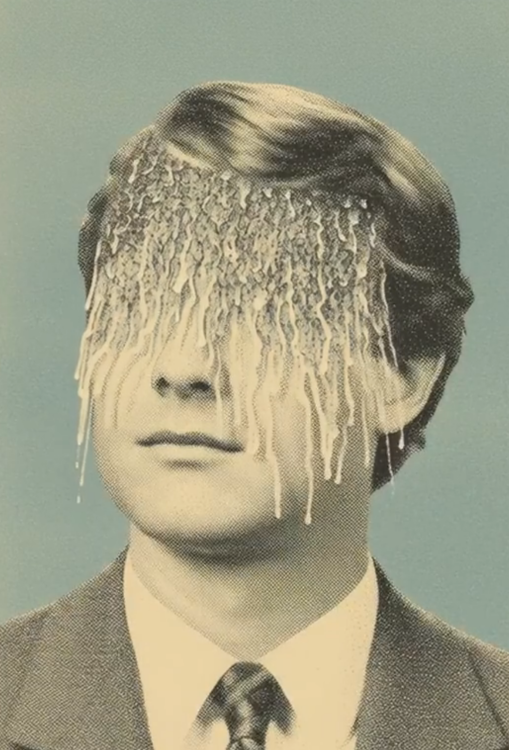
Credit: @WeirdMusicVideos on Meta AI
Again, to be fair, Vibes also shows how far AI video has come in a few short years. There were few instances, at least in this curated creator feed, of hands with too many fingers, torsos with too many limbs, and other features we associate with AI slop. There was often something in a video that looked a little wrong if you looked too closely — for example, why are those people vacationing at the beach looking out to sea, rather than at the dinosaurs charging past them a few feet away on the boardwalk?
But in general, the problem here is not the Uncanny Valley. The problem here is empty calories.
Younger kids may enjoy the weird eye candy aspect for hours on end (Vibes could well be the new Baby Einstein). But the more mature a brain gets, the less it thrives on mere novelty. Brains are storytelling machines, which is why Facebook's infinite scroll was once so compelling. We shared stories, and created our own community stories by arguing with each other about them. Vibes is the video version of the AI slop that has already arguably made Zuckerberg's social network less compelling than ever.
So yes, in one sense, Zuckerberg couldn't be closer to his MTV dream. And in another, the storytelling sense that keeps us coming back to find out what happened next, Meta's infinite slop machine couldn't be any further away.


Today's NYT Strands hints are easy if you're rowdy.
Strands, the New York Times' elevated word-search game, requires the player to perform a twist on the classic word search. Words can be made from linked letters — up, down, left, right, or diagonal, but words can also change direction, resulting in quirky shapes and patterns. Every single letter in the grid will be part of an answer. There's always a theme linking every solution, along with the "spangram," a special, word or phrase that sums up that day's theme, and spans the entire grid horizontally or vertically.
By providing an opaque hint and not providing the word list, Strands creates a brain-teasing game that takes a little longer to play than its other games, like Wordle and Connections.
If you're feeling stuck or just don't have 10 or more minutes to figure out today's puzzle, we've got all the NYT Strands hints for today's puzzle you need to progress at your preferred pace.
NYT Strands hint for today’s theme: Hullabaloo
The words are related to sound.
Today’s NYT Strands theme plainly explained
These words describe ruckus.
NYT Strands spangram hint: Is it vertical or horizontal?
Today's NYT Strands spangram is horizontal.
NYT Strands spangram answer today
Today's spangram is Lets Get Loud.
Mashable 101 Fan Fave: Nominate your favorite creators today
NYT Strands word list for April 24
-
Shout
-
Holler
-
Clamor
-
Lets Get Loud
-
Bellow
-
Whoop
-
Caterwaul
Looking for other daily online games? Mashable's Games page has more hints, and if you're looking for more puzzles, Mashable's got games now!
Check out our games hub for Mahjong, Sudoku, free crossword, and more.
Not the day you're after? Here's the solution to yesterday's Strands.

Today's Wordle answer should be easy to solve if you love a good drink.
If you just want to be told today's word, you can jump to the bottom of this article for today's Wordle solution revealed. But if you'd rather solve it yourself, keep reading for some clues, tips, and strategies to assist you.
Where did Wordle come from?
Originally created by engineer Josh Wardle as a gift for his partner, Wordle rapidly spread to become an international phenomenon, with thousands of people around the globe playing every day. Alternate Wordle versions created by fans also sprang up, including battle royale Squabble, music identification game Heardle, and variations like Dordle and Quordle that make you guess multiple words at once.
Wordle eventually became so popular that it was purchased by the New York Times, and TikTok creators even livestream themselves playing.
What's the best Wordle starting word?
The best Wordle starting word is the one that speaks to you. But if you prefer to be strategic in your approach, we have a few ideas to help you pick a word that might help you find the solution faster. One tip is to select a word that includes at least two different vowels, plus some common consonants like S, T, R, or N.
What happened to the Wordle archive?
The entire archive of past Wordle puzzles was originally available for anyone to enjoy whenever they felt like it, but it was later taken down, with the website's creator stating it was done at the request of the New York Times. However, the New York Times then rolled out its own Wordle Archive, available only to NYT Games subscribers.
Is Wordle getting harder?
It might feel like Wordle is getting harder, but it actually isn't any more difficult than when it first began. You can turn on Wordle's Hard Mode if you're after more of a challenge, though.
Here's a subtle hint for today's Wordle answer:
Intoxicated.
Does today's Wordle answer have a double letter?
There are no recurring letters.
Mashable 101 Fan Fave: Nominate your favorite creators today
Today's Wordle is a 5-letter word that starts with…
Today's Wordle starts with the letter D.
The Wordle answer today is…
Get your last guesses in now, because it's your final chance to solve today's Wordle before we reveal the solution.
Drumroll please!
The solution to today's Wordle is…
DRUNK
Don't feel down if you didn't manage to guess it this time. There will be a new Wordle for you to stretch your brain with tomorrow, and we'll be back again to guide you with more helpful hints. Are you also playing NYT Strands? See hints and answers for today's Strands.
Reporting by Chance Townsend, Caitlin Welsh, Sam Haysom, Amanda Yeo, Shannon Connellan, Cecily Mauran, Mike Pearl, and Adam Rosenberg contributed to this article.
If you're looking for more puzzles, Mashable's got games now! Check out our games hub for Mahjong, Sudoku, free crossword, and more.
Not the day you're after? Here's the solution to yesterday's Wordle.

The Federal Communications Commission is using the presence of "controversial gender identity issues" in children's television programming as a pretense for questioning how TV ratings are developed and enforced, according to a notice published Wednesday by the federal agency.
The notice generally assesses TV ratings, but specifically points out that these industry guidelines have rated shows featuring "transgender and gender non-binary programming" as appropriate for children. It argues that parents aren't provided this information, "thereby undermining the ability of parents to make informed choices for their families."
In the document, the FCC poses a series of open-ended questions about TV ratings development, including whether the board responsible for the guidelines is "sufficiently balanced" with viewpoints outside of the entertainment industry and if faith-based organizations should be represented in the body.
"What more could the board do to include family-oriented perspectives — which are not well represented in the media industry — in its ratings process?" the notice asks.
FCC Chairman Brendan Carr announced the public notice on X, explaining that "parents have raised concerns with the industry's approach." He added that these parents believe "New York & Hollywood programmers" promote objectionable content in kids programming without disclosing that to parents. Carr didn't mention gender identity in his X post.
This Tweet is currently unavailable. It might be loading or has been removed.
TV parents guidelines can include both a rating as well as descriptors for content that includes crude language, sexual situations, and violence.
LGBTQ+ advocates criticized the public notice, arguing that it amounted to discrimination and censorship.
"Trump's FCC is trying to turn transgender people into a warning label," Tyler Hack, executive director of the transgender rights advocacy group Christopher Street Project, said in a statement. "It is dehumanizing, and it is part of a broader political strategy to stigmatize LGBTQ+ people in every corner of public life."
Sarah Kate Ellis, president and CEO of GLAAD, described the notice as government overreach.
"Media companies must be allowed to create and broadcast stories that reflect one-quarter of their audience without interference from a government agency with its own anti-transgender political agenda," Ellis said in a statement.
This isn't the first time Carr has been accused of censorship. Carr has claimed broadcasters air "hoaxes" and "news distortions" that also happen to be unfavorable to President Trump. Carr has suggested the licenses of such broadcasters won't be renewed.
In March, dozens of free speech experts argued in an open letter to Carr that his threats against broadcasters are "unlawful jawboning" and his vague characterization of "fake news" violates the First Amendment. The authors called on Carr to "withdraw" his threats.

Which New Music Release Is Your Favorite This Week? Vote!
Celeb-Loved Juicy Couture T-Shirts Are On Sale for $8 Right Now (If You Hurry)
Head Back to Hawkins With New ‘Stranger Things: Tales From ’85’ Soundtrack

SEND IN THE TROOPS! At Least 5 Dead, 10 Wounded So Far in Chicago Weekend Shootings
How I Paid Off My Mortgage 10 Years Early On A Teacher’s Salary

Black Lives Matter Activist in Boston Pleads Guilty to Federal Fraud Charges – Scammed Donors to Fund Her Lifestyle
-
 Politics1 year ago
SEND IN THE TROOPS! At Least 5 Dead, 10 Wounded So Far in Chicago Weekend Shootings
-
Business1 year ago
How I Paid Off My Mortgage 10 Years Early On A Teacher’s Salary
-
 Politics1 year ago
Black Lives Matter Activist in Boston Pleads Guilty to Federal Fraud Charges – Scammed Donors to Fund Her Lifestyle
-

 Tech1 year ago
Get a lifetime subscription to the “ChatGPT for investors” for under $60
-

 Tech1 year ago
Review: The Dreame H15 Pro CarpetFlex is the first wet/dry vacuum I liked
-
 Tech1 year ago
How much does the Roborock Saros Z70 cost? And does it ever go on sale?
-
Business1 year ago
25 Low-Effort Side Hustles You Can Start This Weekend
-
Business1 year ago
9 Ways to Command a Six-Figure Salary Without a Bachelor’s