
Politics
House reduces pool of money available for IT modernization

Agencies looking for extra funding for IT modernization projects in fiscal 2026 may have a harder time finding it.
House lawmakers reduced funding in the traditional accounts used to bolster IT modernization efforts across the board in its version of the Financial Services and General Government appropriations bill.
House appropriators zeroed out the Technology Modernization Fund for the third straight year with the passage of the 2026 FSGG bill on Sept. 3. Legislators cut the Federal Citizen Services Fund and reduced the amount of money available in the IT Oversight Reform (ITOR) fund.
“The advancement of this bill is a sign that we are one step closer to fiscal discipline and common sense within our own federal government. It caps federal spending to ensure responsible use of taxpayer dollars, modernizes technology infrastructure to increase efficiency and effectiveness, and strengthens national security by preventing bad actors from taking advantage of our financial system,” said Financial Services and General Government Subcommittee Chairman Dave Joyce (R-OH) in a release.
The House appropriations approved the bill 35 to 28.
Here is a breakdown of the cyber and IT funding highlights from the bill.
Federal Citizen Services Fund
- 2025: $75 million
- 2026 request: $70 million
- House 2026 bill: $55 million, of which $5 million should be used for hiring employees to support the implementation of the Foundations for Evidence-Based Policymaking Act of 2018
“The committee welcomes efforts to increase federal agencies’ access to secure cloud computing products and services. To that end, the committee appreciates efforts to improve the Federal Risk and Authorization Management Program (FedRAMP), including the recently announced FedRAMP 20x effort. However, the Committee remains concerned about a lack of detail from GSA. Therefore, the committee directs the General Services Administration to provide a briefing to the House and Senate appropriations committees on the implementation plan for FedRAMP 20x within 90 days of enactment of this act.”
Technology Modernization Fund
- 2025: $0
- 2026 request: $0
- House 2026 bill: $0
The House bill didn’t include any explanation of why it zeroed out the TMF. The Senate has not yet moved on its version of the FSGG bill.
The additional rationale for not giving the TMF any new money, besides the appropriators disdain for these types of funding mechanisms, can be found in GSA’s 2026 budget justification.
GSA wants to make it a revolving or working capital fund of sorts.
The legislative proposal would let “GSA, with the approval of OMB, to collect funding from other agencies and bring that funding into the TMF,” GSA wrote in its budget justification document. “This would allow agencies to transfer resources to the TMF using funds that are otherwise no longer available to them for obligation. This provision is essential to providing the TMF with the necessary funds to help the federal government address critical technology challenges by modernizing high-priority systems, improving AI adoption and supporting cross-government collaboration and scalable services.”
GSA wants to be able to collect up to $100 million a year in otherwise expired funding. The TMF funding would be no-year money as well.
The TMF only has made one new award to agencies in 2025 and is estimated to have over $220 million in available funding.
IT Oversight Reform Fund
- 2025: $8 million
- 2026 request:$19.6 million
- House 2026 bill: $10 million
“The committee recommends $10 million for ITOR, of which $5 million is provided to the Office of the Chief Information Officer and $5 million to the United States DOGE Service (DOGE). The committee further directs the administrator of DOGE to submit quarterly reports to the House and Senate committees on appropriations on the number of hires for DOGE, including the use of detailees and transfers to and from an agency for personnel.”
The House is cutting the among of money the Federal CIO’s office has to support certain IT modernization and cybersecurity efforts like establishing the child tax credit website and strategy and modernizing the Department of Agriculture’s Special Supplemental Nutrition Program for Women, Infants and Children program.
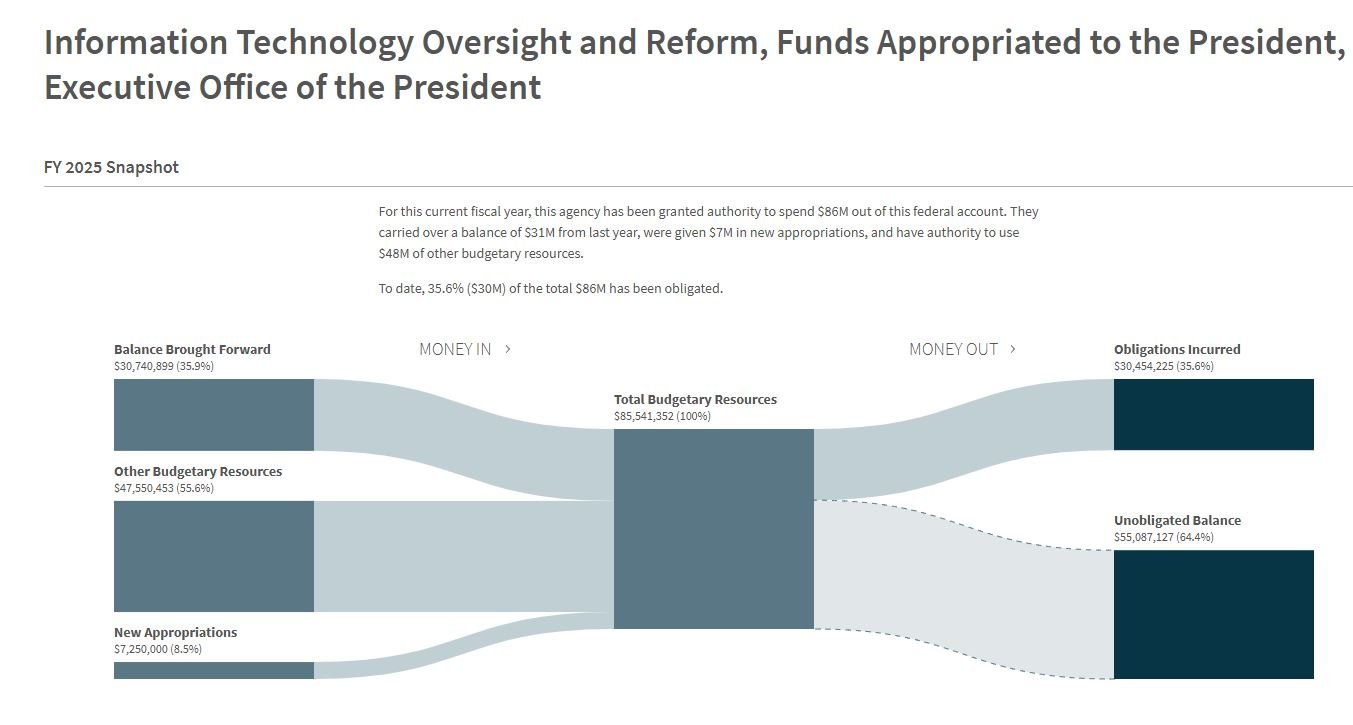
ITOR also has the ability to carry over funding from previous years. According to USASpending.gov, OMB has more than $55 million left for 2025. It started out with over $85 million, $30.7 million of which carried over from previous years.
Source: USASpending website, August 2025.
In many cases over the years, the Office of Management and Budget uses money from all three funds to support governmentwide modernization programs.
In OMB’s 2022 IT operating plan, former Federal CIO Clare Martorana wrote, “The funds have different and complementary strengths that stem from their inherent purposes and variations in the operating models of the implementing organizations.”
Treasury’s Cybersecurity Enhancement Account
- 2025 appropriation: $36.5 million
- 2026 request: $59 million
- House 2026 bill: $99 million
“The committee recommends $99 million for the CEA. The recommendation includes an increase for zero trust architecture implementation, low code application development and cloud enterprise cybersecurity enhancements.”
The committee is asking Treasury for quarterly plans to the appropriations committees detailing how it plans to spending the money for each CEA investment. The first one would be due 60 days after the bill becomes law.
“The committee is concerned by the infiltration of Chinese hackers into the department’s information technology systems, which resulted from vulnerabilities associated with the department’s third-party service provider,” the House report stated. “The plan shall include prior year unobligated balances and identify planned obligations by source year of appropriation. The plan shall also include anticipated unobligated balances at the close of the fiscal year and the planned obligation of carryover in future years by quarter until all funds are obligated. The department is directed to submit quarterly updates on the status of implementing this plan. The plan shall also identify any agreement or areas of cooperation with members of the intelligence community to strengthen its cybersecurity platform.”
Office of the National Cyber Director
- 2025 appropriation: $21.7 million
- 2026 request: $20 million
- House 2026 bill: $18.1 million
The committee didn’t offer much insight into why it reduced ONCD’s budget for 2026. It did, however, tell ONCD that it should spend more time on securing federal data.
“A significant portion of today’s cybersecurity vulnerabilities occur outside of traditional legacy and enterprise investments made for localized agency network protections when data is in transit, due to various automated routing and switching protocols via systems and infrastructure potentially controlled or subject to manipulation by adversarial threats. The ONCD is encouraged to work with the Cybersecurity and Infrastructure Agency to ensure best practices are followed with lessons learned from the Department of Defense’s mapping methodology and data format.”
The post House reduces pool of money available for IT modernization first appeared on Federal News Network.

Politics
PAYBACK TIME: US Department of War Planning Retribution for Failing Allies, Including Suspending Spain From the Alliance and ‘Reviewing’ UK’s Claims to the Falkland Islands
 Failing allies, leftist-Globalists Sanchez (Spain) and Starmer (UK) are about to taste retribution from Trump – Wiki Commons
Failing allies under pressure.
As we have been reporting here on TGP, US President Donald J. Trump is hardly the man to forgive and forget a slight or a betrayal.
And it’s been reported that Trump and his team have compiled a ‘naughty list’ of failing allies, and that some for of payback was expected against these countries.
And today, it arises that the Pentagon is exploring ways to punish NATO countries that failed to support the US during the Iran conflict – including drastic measures like suspending Spain from the alliance.
BREAKING:

US assessing to suspend Spain from NATO. pic.twitter.com/wQHSkamAbr
— Crypto Rover (@cryptorover) April 24, 2026
This was first reported by Reuters, but was picked up by a multitude of outlets, primarily in the UK, where there is widespread concern over the planned US ‘review’ of the British claim to the Falkland Islands.
Trump could ‘review’ Britain’s Falklands claim as he tries to punish NATO members over Iran warhttps://t.co/r1cOslEzZP pic.twitter.com/27c5E3VTiB
— The Mirror (@DailyMirror) April 24, 2026
Daily Mail reported:
“The policy options are detailed in an email expressing frustration at some allies’ perceived reluctance or refusal to grant Washington access, basing and overflight (ABO) rights for the Iran war. The email stated that ABO is ‘just the absolute baseline for NATO,’ according to the official, who added that the options were circulating at high levels in the Pentagon.
The memo also includes an option to consider reassessing US diplomatic support for longstanding European ‘imperial possessions,’ such as the Falkland Islands near Argentina.”
Needless to say, the response by the Euro-Globalists was immediate.
On the one hand, NATO states there is no provision to oust Spain, while the UK reaffirms its sovereignty over the South American Islands.
Nato says US cannot suspend Spain from alliance, after reported Pentagon email https://t.co/mX8Ccib2M8
— BBC News (UK) (@BBCNews) April 24, 2026
Trump could ‘review’ Britain’s Falklands claim as he tries to punish NATO members over Iran warhttps://t.co/r1cOslEzZP pic.twitter.com/27c5E3VTiB
— The Mirror (@DailyMirror) April 24, 2026
Read more:
NATO and the Bar Fight: A Bar Tab Europe Expects America To Pay Forever
The post PAYBACK TIME: US Department of War Planning Retribution for Failing Allies, Including Suspending Spain From the Alliance and ‘Reviewing’ UK’s Claims to the Falkland Islands appeared first on The Gateway Pundit.
Politics
AXIS OF ECONOMIC LOSERS: Japan and Germany’s Socialist “Stakeholder” Takeover Turned Economic Superpowers Into Stagnant Ghost Towns – And the Left Wants This Poison for America

 Japan and Germany are dying from the same disease: socialism.
Back in the late 1980s and early ’90s, the so-called “experts,” the mainstream media, and every smug Ivy League economist couldn’t stop drooling over Japan. “Japan as Number One!” they screamed. Books flew off the shelves. Newsweek and Time covers warned of an “economic Pearl Harbor.”
Paul Harvey wailed about Japan buying up America with our own money. Paul Kennedy’s bestseller The Rise and Fall of the Great Powers basically coronated the Land of the Rising Sun as the next global hegemon.
The keiretsu system, the MITI bureaucrats, the lifetime employment model — it was all supposed to be the future. America was finished. The Japanese were going to own us.
Fast-forward to 2025-2026. Japan is a cautionary tale on life support. GDP per capita (PPP) hovers around a pathetic $55,000–$56,000 — crushed by America’s nearly $94,000. After taxes and cost of living? It’s even worse. The “Lost Decades” aren’t a glitch — they’re the feature. Zombie companies, endless stagnation, and a demographic death spiral made infinitely worse by policies that treat businesses like government welfare offices rather than wealth-creation machines.
The mainstream press will blame everything except the real culprit: the deliberate socialization of the corporation.
Keiretsu
In Japan, it’s the infamous keiretsu system — giant corporate clans glued together by cross-shareholdings and a house bank that plays mommy to every failing division. Lifetime employment. Seniority-based pay and promotions instead of merit. Company unions that treat every layoff like a war crime. The goal isn’t profit — heaven forbid — it’s “harmony” and keeping everyone employed forever. Result? Total paralysis. You can’t fire the dead weight. You can’t reallocate capital to what actually works. You can’t innovate like a maniac because revolution is “disruptive.”
When the 1990s bubble popped, they didn’t clean house — they dragged toxic debt around like a ball and chain for decades.
And don’t look now, but Germany — once the envy of Europe — is right there with them in the loser’s club. Years of zero or outright negative growth. Factories shuttering. The proud German export machine is coughing up blood. The vaunted “Rhine model” has turned into a slow-motion industrial suicide.
Mitbestimmung
Because Germany took the socialization even further with the notorious Mitbestimmung — “co-determination.” In big companies, workers and union reps literally occupy half the seats on the supervisory board. They get veto power over layoffs, plant closings, relocations, and major restructurings. It’s not capitalism anymore — it’s corporate communism with better engineering. The boardroom isn’t deciding how to crush competitors and reward shareholders; it’s negotiating how to protect today’s insiders at the expense of tomorrow’s growth.
Add in the deranged Energiewende — the green energy fantasy that tripled electricity costs — and you have the perfect storm. German industry is literally powering down while the rest of the world races ahead.
BMW/Tesla
Want proof? Look at BMW versus Tesla. BMW sells about 2.5 million vehicles a year. Tesla sells around 1.5 million. BMW’s market cap? A measly ~$55 billion. Tesla’s? Over twenty times higher. One company is run by visionaries who embrace the future and reward risk-takers. The other is run like a German labor ministry with a side hustle in cars.
This is what happens when you let “stakeholders” — code for unions, bureaucrats, and professional grievance-mongers — hijack the boardroom. The enterprise stops being a profit machine that lifts everyone through growth and becomes a social-work project designed to protect yesterday’s workers at the expense of tomorrow’s entrepreneurs, young people, and innovators.
It’s the exact same philosophy the American left has been trying to smuggle into U.S. boardrooms for years: ESG scores, “stakeholder capitalism,” DEI mandates, union power grabs, and the constant war on shareholders. They call it compassionate. It’s actually economic castration. Joseph Schumpeter’s “creative destruction” — the engine of real progress — gets sacrificed on the altar of Karl Marx’s class warfare dressed up in a suit and tie.
America’s model is raw, unapologetic, and brutally effective: The company exists to make money for its owners. Management executes or gets fired. You restructure, you pivot, you kill failing divisions without crying about “humanity.” It looks ugly to the European and Japanese salon socialists. It also creates the iPhones, the SpaceX rockets, the shale revolution, and the stock market that funds retirements for millions.
The Axis of Losers
Japan and Germany didn’t fail because of demographics or one bad energy policy. They failed because they turned their greatest companies into paralyzed extensions of the welfare state. The “Axis of Losers” chose preservation over progress — and they’re paying for it in lost decades and lost futures.
America still has a choice. We can reject this European-Japanese corporate socialism, tell the unions and the stakeholder grifters to pound sand, and keep rewarding the risk-takers and wealth-creators who actually build the future.
Or we can follow the Axis of Losers straight into the economic graveyard. The choice should be obvious — but the radical left never learns. They just rebrand failure as “equity” and keep selling the same poison. Don’t let them.
The post AXIS OF ECONOMIC LOSERS: Japan and Germany’s Socialist “Stakeholder” Takeover Turned Economic Superpowers Into Stagnant Ghost Towns – And the Left Wants This Poison for America appeared first on The Gateway Pundit.
Politics
WATCH: Mother of Feral NYC Teen Who Body-Slammed and Stomped 15-Year-Old Girl’s Head DEFENDS Violent Son, Claims Victim ‘Bullied’ Him After She Refused to Give Him Her Phone Number


A horrifying video from New York has sparked nationwide outrage after a 14-year-old boy was caught on camera brutally body-slamming a 15-year-old girl to the concrete and then stomping on her head, all because she refused to give him her phone number.
Now, the boy’s mother is publicly defending her son, claiming the victim was “bullying” him and that his savage and animalistic attack was somehow justified because he is a “humble” Christian.
The shocking attack occurred around 3:30 p.m. on Monday at the corner of East 107th Street and Third Avenue in East Harlem, just after school let out.
The 15-year-old girl, a ninth-grade student-athlete at East Harlem Scholars Academy Charter School heading to squash practice, was confronted by the 14-year-old masked suspect, who had reportedly been harassing her for weeks.
In the disturbing footage, the girl is seen trying to walk away and yelling, “Get the f–k away from me.”
The boy follows her, grabs her from behind, lifts her off the ground, slams her to the pavement, and then stomps directly on her head.
His friends can be heard laughing and egging him on as the girl lies motionless on the ground.
WATCH (VIEWER DISCRETION ADVISED):
A New York City teen was arrested after body-slamming a girl and stomping on her head because she refused to give him her number.
pic.twitter.com/Snm8yThMKM
— Rain Drops Media (@Raindropsmedia1) April 23, 2026
The girl suffered a concussion and was rushed to Harlem Hospital.
The 14-year-old suspect was arrested on Wednesday and appeared in Manhattan Family Court, where he was ordered held in custody by the Division of Youth and Family Justice.
Because both parties are minors, his name has not been publicly released.
In an interview captured outside the courthouse, the boy’s mother, Selma Allen, issued a wild defense of her violent son.
WATCH:
Mother defends son who stomped on 15-year-old girl’s head in East Harlem after she refused to give him her number — and claims he was bullied by the victim. https://t.co/ljsuW0np3w pic.twitter.com/WSLTFbDOKH
— Rain Drops Media (@Raindropsmedia1) April 24, 2026
Allen claimed the 15-year-old girl had been bullying him in school, sending messages, and even pushing him down, and that this somehow justified the vicious attack.
“She was being a bully to him, that’s it,” Allen told reporters.
“He’s been complaining about her. I bring it to the principal’s attention but he don’t address it. The way my son is being bullied, he doesn’t want to go to school.”
She claimed her son is a “quiet” boy who “doesn’t provoke nobody,” and described him as a “humble Christian.”
“He don’t provoke nobody. But if you provoke him, he will lash out.”
Allen insisted her son had proof on WhatsApp and Instagram and repeatedly shifted blame onto the victim while downplaying the savage stomp on the girl’s head.
None of the reporters asked the obvious question: if the girl was truly bullying him, why was he aggressively demanding her phone number and following her?
The victim’s mother, Lucinda Arroyo, spoke out Thursday in an interview with the New York Post. She said her daughter had been dealing with weeks of harassment from the boy and said it was a “miracle” her daughter survived.
“She’s very upset that her whole life has been completely flipped upside down right now,” Arroyo said. “She’s known him as someone who’s bad news for a while.”
“This is not even bullying, this is outright assault — and he could have killed her,” she asserted.
Her daughter was left with a concussion, bleeding, a potential brain injury, crushing headaches and a twisted neck, and will require ongoing physical therapy.
The post WATCH: Mother of Feral NYC Teen Who Body-Slammed and Stomped 15-Year-Old Girl’s Head DEFENDS Violent Son, Claims Victim ‘Bullied’ Him After She Refused to Give Him Her Phone Number appeared first on The Gateway Pundit.

Which New Music Release Is Your Favorite This Week? Vote!
Celeb-Loved Juicy Couture T-Shirts Are On Sale for $8 Right Now (If You Hurry)
Head Back to Hawkins With New ‘Stranger Things: Tales From ’85’ Soundtrack

SEND IN THE TROOPS! At Least 5 Dead, 10 Wounded So Far in Chicago Weekend Shootings
How I Paid Off My Mortgage 10 Years Early On A Teacher’s Salary

Black Lives Matter Activist in Boston Pleads Guilty to Federal Fraud Charges – Scammed Donors to Fund Her Lifestyle
-
 Politics1 year ago
SEND IN THE TROOPS! At Least 5 Dead, 10 Wounded So Far in Chicago Weekend Shootings
-
Business1 year ago
How I Paid Off My Mortgage 10 Years Early On A Teacher’s Salary
-
 Politics1 year ago
Black Lives Matter Activist in Boston Pleads Guilty to Federal Fraud Charges – Scammed Donors to Fund Her Lifestyle
-

 Tech1 year ago
Get a lifetime subscription to the “ChatGPT for investors” for under $60
-

 Tech1 year ago
Review: The Dreame H15 Pro CarpetFlex is the first wet/dry vacuum I liked
-

 Tech1 year ago
How much does the Roborock Saros Z70 cost? And does it ever go on sale?
-
Business1 year ago
25 Low-Effort Side Hustles You Can Start This Weekend
-
Business1 year ago
9 Ways to Command a Six-Figure Salary Without a Bachelor’s