Saudi National Orchestra and Choir
Billboard Arabia


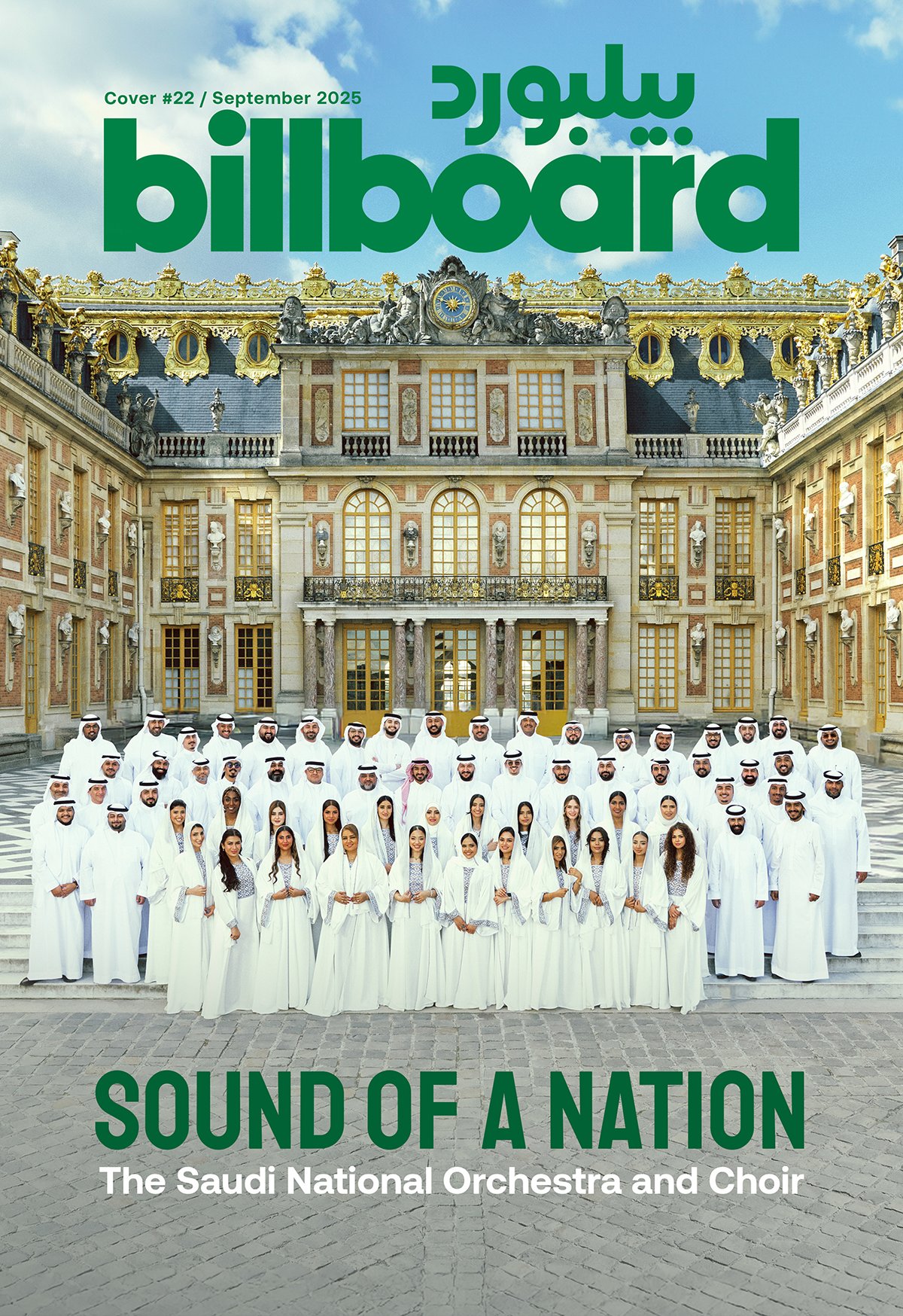
At the Palace of Versailles, on the eve of Saudi Arabia’s National Day (Sept. 23), the latest tour of the Saudi National Orchestra and Choir—part its Marvels program—brought together over 100 Saudi musicians, each with their own journey and story.
In early September, Versailles wrote an unfamiliar chapter in its long history. The same walls that once carried the sounds of French royal court music reverberated this time with a new rhythm. Among corridors filled with Europe’s old grandeur, the voices and instruments of the Saudi National Orchestra and Choir declared that the Kingdom now speaks to the world in a new language: the language of music.
This was more than a concert. It was a symbolic scene that captured the essence of a growing cultural movement—reflecting Saudi Arabia’s transformation as it reshapes its image through strings, voices and melodies.
Founded in 2019 under the Music Commission, the orchestra and choir were never meant to be just another musical troupe. Their mission was bigger: to create an academic environment for Saudi musicians and give local heritage a global platform.
The Marvels tour has already traveled through Paris, New York, London, Sydney, Tokyo and Mexico City. Versailles was not only another milestone in Europe’s most storied palace, but also a moment when a new generation of Saudi musicians stood proudly before the world—offering an image of their country that emerges from within, yet opens outward with confidence and passion.
The orchestra’s first international stop was Paris in 2022, where The Masterpieces of the Saudi National Orchestra and Choir debuted. The tour expanded to Mexico City, New York, London, Sydney and Tokyo, before returning home in early 2025 for a performance in Riyadh. In August this year, another Riyadh concert celebrated the graduation of the first cohort of the Saudi National Orchestra and Choir’s Music Education Program after two years of training.
The tour carved a bridge between Saudi music and global audiences by adapting performances to resonate with each culture. In London, traditional song “Addayt fi Marqab” was fused with an Adele medley. In New York, Frank Sinatra’s classic “Fly Me to the Moon” was reimagined with Eastern rhythms. In Tokyo, audiences heard anime themes performed in Arabic.
At Versailles, in a 90-minute performance, the orchestra blended Saudi traditional and contemporary music with folk dances such as khibaiti, majroor and khutwa—before shifting into French and even operatic singing. The highlight came with a joint performance alongside the Royal Opera Orchestra, conducted by Egyptian maestro Hany Farhat—the first Arab ever to lead the French orchestra. The following day, Saudi conductor Reaab Ahmed took the baton, becoming the first Saudi maestro to lead the national orchestra.
What makes this project remarkable is not just its academic foundation but also the diversity within its ranks. Behind the unified sound stand of over 100 musicians with unique stories.
Some left entirely different careers to follow music: Adwaa Shanan once practiced clinical psychology, Ma’an Al-Yamani worked as a sales consultant, Maha Abdullah in medical care while Ibrahim Al-Rashed, a pianist, was a network engineer. For them, joining the choir was a life-changing moment.
Their musical tastes are just as varied. Nawaf Al-Jizani, the youngest member, loves classical music—an influence from his father, though he admits to listening to rap like most of his generation. Chorister Fatimah Zahid shone in Versailles with her rendition of “Les Champs-Élysées” in French. Hataf and Taghreed Al-Shahrani prefer old Arabic songs, while Horia leans toward R&B.
Backstage, each musician carried a different mood and style, but once on stage, differences dissolved into one shared voice. That diversity—seemingly contradictory—gives the orchestra and choir their unique identity: individual tastes converging into a collective national sound.
The orchestra and choir did not choose the easy path of merely performing existing Western classics. Instead, they placed Saudi music at the heart of their repertoire—songs by icons like Mohammed Abdu and Talal Maddah, and folk traditions such as samri, majroor and mizmar yanbawi—all reimagined in modern orchestral arrangements.
“Saudi music carries within it dignity, majesty and solemnity,” said qanun player Yazid Al-Aidi. The project preserved this essence while placing it in a classical frame, allowing the world to hear Saudi music as Saudis do—not replacing identity, but expanding its reach to new audiences.
Saudi soprano Reemaz Al-Oqbi embodies both pride and realism. Trained in opera since childhood, she knows the challenges of pioneering a new cultural era—especially for women in a fast-changing society.
“Studying music from a young age gave me a different perspective, to see it as a real profession,” she said. “We are building from scratch in Saudi Arabia—but building a strong foundation, an environment where musicians can live with dignity and a clear future. It’s harder for women, but thank God, the opportunities are now here.”
Between exhausting rehearsals and the thrill of audience applause, unforgettable moments stand out.
“The best moments are in the final days before travel, when the choir and orchestra come together and we finally see the full picture,” said Hassan Al-Mahouzi. For Nawaf Abdulhadi, joy comes when the choir conquers a difficult phrase in perfect unison. For Wahib Al-Salem, the performance day itself feels like a holiday: “The concert is like Eid.”
Yet all agree that the climax comes in the finale, when they bow and hear the applause. As chorister Rose put it: “The most beautiful moment is when the stage glows green”—the color of the Saudi flag, symbolizing both national pride and collective achievement.
At the Versailles concert, Saudi Minister of Culture Prince Badr bin Abdullah bin Farhan declared: “Culture is a driving force for sustainable development, a key engine of economic and social growth, and a source of inspiration for future generations to build a better world filled with dialogue, stability and prosperity.”
The Saudi National Orchestra and Choir’s presence at Versailles was more than a performance. It was a symbolic announcement that Saudi Arabia is writing its cultural story with the voices of its sons and daughters. Each note testified to the transformation of a society opening to the future without abandoning its roots.
When over 100 musicians merge into one voice, the boundaries between individual and collective, past and present, local and global, blur—capturing the very essence of Saudi Arabia’s vision: a story that begins from within yet speaks to the world with confidence and creativity.
Saudi National Orchestra and Choir
Billboard Arabia
It’s the final new music Friday (April 24) of the month, and everyone from Noah Kahan to Kehlani and Suki Waterhouse have put forth some of their best work as May waits just around the corner.
This week, Vermont’s favorite folk-rock singer-songwriter finally returned with a new album after four years of Stick Season, his breakout album that reached No. 2 on the Billboard 200. The Great Divide is 17 tracks of Kahan reexamining his worldview after struggling with his mental health in the years since he found fame.
And, as if taking cues from the success of first-ever Billboard Hot 100 top 10 hit “Folded” (which reached No. 6 on the chart in January), Kehlani leans fully into classic R&B flavors in an intentional push to recenter the genre’s traditions. “All the R&B artists, we want R&B to be back,” the artist told Billboard ahead of being named Billboard Women in Music’s Impact honoree. “We want good, long songs. We want three verses and bridges and modulations and all the things – we want that too. We just didn’t think anybody else wanted it. I have an allegiance to the genre, and I’ll keep it there.”
On top of the bounty of new albums, several artists have released fresh singles — including Suki Waterhouse, who returns with “Tiny Raisin” shortly after announcing her next album, Loveland, as well as Hayley Kiyoko and Gigi Perez, who teamed up for heartfelt duet “Collide.” Plus, Dylan Gossett adds “My Boy” to the mix, written as a letter to his son.
But which release is your favorite this week? Let Billboard know by voting in the poll below.

All products and services featured are independently chosen by editors. However, Billboard may receive a commission on orders placed through its retail links, and the retailer may receive certain auditable data for accounting purposes.
It’s been almost three decades since the LA-based casual wear brand Juicy Couture first hit store shelves, and the Hollywood-loved label has made its way back into the spotlight in recent years thanks to the Y2K trend resurgence and newfound love from influencers online.
Best known for its T-shirts, handbags and yes, those velour tracksuits (reportedly designed exclusively for Madonna at first), Juicy Couture pieces were seen on practically every major celebrity in the 2000s, from Paris Hilton and Britney Spears, to Jennifer Lopez and Kim Kardashian. Musicians like Miley Cyrus, Nicole Scherzinger and even Beyoncé have also been spotted wearing Juicy Couture, and now, a new Amazon deal makes it easy for you to get into some JC as well.

LIMITED TIME DEAL
Amazon is selling a five-pack of Juicy Couture T-shirts right now for just $39. Part of the “Juicy Sport” line, the cropped T-shirts are made from a super soft and breathable “performance” fabric that features a touch of spandex for easy movement and stretch.
That makes the T-shirts as ideal for a workout or yoga session as they are for pairing with your everyday ‘fits. The crop top look leans into the Y2K aesthetic and Amazon’s website shows the shirts styled with shorts, leggings and mini skirts alike.
This Amazon deal gets you five Juicy Couture T-shirts for under $40. That brings the price of each tee down to less than $8 — a virtually unheard of deal for generic T-shirts, let alone a brand name pick.
We like the five-pack above, which gets you a T-shirt in two shades of pink (including a light pink with the signature Juicy Couture cherries), plus navy blue, gray and black. You can choose from other color combinations online. The tees are available in sizes small to XXL.

ALSO AVAILABLE
Don’t need five T-shirts? Amazon also sells a three-pack of Juicy Couture tees for just $30, bringing the price of each individual shirt to under $10.

ALSO CONSIDER
And if you need a bag to take to the gym (or for an overnight stay), we like this mini barrel-style duffle bag, on sale for 43% off. The two-tone bag measures approximate 8.2 x 4.9 inches in size, which is enough room for your wallet, keys, change of clothes and toiletries. Choose to carry the bag via the top handle or with the detachable shoulder straps.
All of the above picks are officially-licensed products sold through Amazon’s Juicy Couture storefront. As with all Amazon deals, the sale prices could end at anytime, so we recommend adding the deals to cart while they are still live.
Netflix is bringing us back to the ’80s, and it’s making sure we have the right music for the occasion.
On Wednesday (April 22), Billboard can exclusively reveal that an original soundtrack is coming this week for the brand-new animated spin-off series Stranger Things: Tales From ’85. The score album, composed by Brad Breeck (Gravity Falls, We Bare Bears), will be released globally Thursday (April 23) at midnight ET.
Stranger Things: Tales From ’85 also arrives Thursday on Netflix, bringing viewers back to the fictional town of Hawkins, Indiana, in the ’80s and reuniting us with some of the original show’s main characters. And much like Stranger Things, music plays a large role in the new show.
“This collection bridges the gap between the eerie depths of the Upside Down and the vibrant, neon energy of the mid-’80s,” Netflix said in a statement.
Tales From ’85 will feature not only a brand-new version of the original Stranger Things theme song, but the first episodes also include a selection of ’80s hits from artists like Black Sabbath, Billy Idol, Cyndi Lauper and more. Needle drops throughout the series include “We Got the Beat” by The Go-Go’s, “A Forest” by The Cure and “We’ll Meet Again” by Vera Lynn, “Rebel Yell” by Idol, and Lauper’s Billboard Hot 100 chart-topper “Time After Time.”
If it’s anything like the original show, artists with songs played in the new series could see a bump in streams and chart placements in the aftermath of the show’s premiere. After featuring the songs in pivotal moments, Stranger Things brought Kate Bush‘s “Running Up That Hill (A Deal With God)” to a new peak of No. 3 on the Hot 100 in 2022, 37 years after its initial release, while Metallica’s “Master of Puppets” made its debut on the chart the same year, 36 years after it came out.
Fans can pre-save Stranger Things: Tales From ’85 (Soundtrack from the Netflix Series) by Brad Breeck here, and find the full score track list below.

Flamethrower (artists: Brad Breeck feat. Brian Parkhurst)
Kids Riding Bikes
Big Snowstorm Coming
Someone In There
HIC Theme
I Just Saved Your Life
Strange Stones
Gotta Go Dark
How Long Is Detention
Sewer Chase (artists: Brad Breeck feat. Brian Parkhurst)
Towns
Clean Up
Investigating Pumpkins
Heaven Eleven
Nice Time Tonight
Storm the Gates
What Were These Things
Ground Rules
seluR dnuorG
Her Royal Nastiness
We Have To Try
Tales from ’85 End Titles (artists: Brad Breeck feat. Cooper Babbes)



SEND IN THE TROOPS! At Least 5 Dead, 10 Wounded So Far in Chicago Weekend Shootings
How I Paid Off My Mortgage 10 Years Early On A Teacher’s Salary

Black Lives Matter Activist in Boston Pleads Guilty to Federal Fraud Charges – Scammed Donors to Fund Her Lifestyle


Get a lifetime subscription to the “ChatGPT for investors” for under $60


Review: The Dreame H15 Pro CarpetFlex is the first wet/dry vacuum I liked
25 Low-Effort Side Hustles You Can Start This Weekend


How much does the Roborock Saros Z70 cost? And does it ever go on sale?
9 Ways to Command a Six-Figure Salary Without a Bachelor’s