
Entertainment
Amy Poehler, PBS Kids to Be Honored at 2026 Peabody Awards


Actress and podcast host Amy Poehler will receive the Peabody Career Achievement Award at the 86th annual Peabody Awards ceremony on May 31 at the Beverly Wilshire Hotel in Beverly Hills, Calif. Director, producer and screenwriter Sterlin Harjo will be honored with the Peabody Trailblazer Award. PBS KIDS will receive the Peabody Institutional Award.
Snoop Dogg Presents Amy Poehler With Inaugural Best Podcast Award at 2026 Golden Globes: ‘This Is Exactly How I Pictured It’
Regina Spektor Opens Children’s & Family Emmys With ‘Won’t You Be My Neighbor?’ Cover: Full Winners List
The Career Achievement Award recognizes an individual whose exceptional body of work and creative contributions have made a significant impact on media and culture. Past recipients include Andrea Mitchell, Mel Brooks and Sam Pollard. The Trailblazer Award recognizes visionaries whose innovative storytelling styles impact culture and affect social change. Previous recipients include Ahmir “Questlove” Thompson, Quinta Brunson and Issa Rae. The Institutional Award recognizes institutions and organizations, as well as series and programs, for their enduring body of work and their lasting impact on the media landscape and the public imagination. Previous recipients include Saturday Night Live, Fresh Air With Terry Gross and 60 Minutes.
“These honorees represent the very best of storytelling in media and the profound impact it can have on culture,” Jeffrey Jones, executive director of the Peabody Awards said in a statement. “Amy Poehler has built a remarkable career bringing intelligence, humor and fearless creativity to work that continues to shape comedy and inspire audiences. Sterlin Harjo has expanded the possibilities of television with work that is both deeply personal and culturally groundbreaking, with overdue stories and voices Americans have long ignored. And for decades, PBS KIDS has set the gold standard for educational children’s media, creating thoughtful, enriching stories that continue to shape how young audiences learn, grow and understand the world. We’re proud to recognize each of them for their lasting impact on the media landscape.”
Poehler is best known for starring in and helping shape the NBC comedy Parks and Recreation, which won a Peabody Award, and for her eight-season run on Saturday Night Live. Through her Paper Kite Productions, Poehler has produced culturally influential series including Broad City, Russian Doll and Harlem, and has directed projects such as Wine Country and the Peabody-nominated documentary Lucy & Desi. She recently reprised her role as Joy in Disney’s blockbuster Inside Out 2, the highest grossing animated film of all time, and hosts the hit video podcast Good Hang With Amy Poehler, which won the inaugural best podcast award at the 2026 Golden Globe Awards.
A MacArthur “Genius” Fellow, Sterlin Harjo (Seminole/Mvskoke) created, wrote, directed and is the executive producer of The Lowdown, starring Ethan Hawke, which is currently airing on FX and Hulu. Previously, he was the showrunner, cocreator with Taika Waititi and director of Reservation Dogs for FX. The series ran for three seasons and received numerous awards including a Gotham Award, two Peabody Awards, two Independent Spirit Awards and honors from the Television Academy.
PBS KIDS, the children’s educational media brand of the Public Broadcasting Service, serves young audiences across the United States through streaming and on-air content, games and community-based initiatives. Since the launch of PBS KIDS as a dedicated programming block in 1999, the brand has become a central presence in public broadcasting, building on earlier children’s programming created by pioneers such as Fred Rogers and Jim Henson.
Its programming for children ages 2 to 8 includes series such as Daniel Tiger’s Neighborhood, Carl the Collector, Wild Kratts and Alma’s Way, alongside a wide range of educational games and resources for parents, caregivers and teachers. A cornerstone of the PBS KIDS mission is to support children’s learning through its partnership with local PBS stations across the country to ensure this programming and interactive learning content is available for free to families everywhere.
The Peabody Awards’ mission statement is to “honor stories that defend public interest, encourage empathy and expand our understanding of the world.” Nominees for the 2026 Peabody Awards will be announced on April 7 and April 9, with winners announced later that month. Winners will be celebrated on Sunday, May 31. All proceeds from the annual ceremony support the organization’s ongoing programs and initiatives.


BMG has sued Anthropic for copyright infringement, joining the ranks of other large music rightsholders that have entered the AI litigation fray.
The various publishing arms of BMG filed a lawsuit on Tuesday (March 17) against the behemoth company, which is behind the popular AI chatbot Claude. BMG alleges the model was trained on lyrics from unlicensed songs, including Billboard Hot 100 chart-toppers like Ariana Grande’s “7 Rings” and Bruno Mars’ “Uptown Funk,” and now spits out infringing lyrics when prompted.
“Anthropic has blatantly violated the copyright laws and caused direct harm to BMG and the songwriters it proudly represents,” reads the lawsuit, filed on BMG’s behalf by powerhouse entertainment law firm Manatt Phelps & Phillips. “Generations of inventors have brought revolutionary new products to market while complying with copyright law. Anthropic’s rapid development of its new technology is no excuse for its egregious law-breaking.”
The lawsuit closely resembles separate copyright litigation already brought against Anthropic by Universal Music Publishing Group (UMPG), Concord Music and ABKCO Music. It’s not clear why BMG opted to bring its own case rather than join the other publishers, who’ve been fighting Anthropic in court since 2023. Notably, Billboard recently reported that BMG and Concord are in talks to merge.
BMG says in Tuesday’s complaint that it sent a cease-and-desist letter to Anthropic in December, but that the AI company never responded. A BMG spokesperson told Billboard on Wednesday (March 18) that Anthropic’s conduct “stands in direct opposition to the standards required of any responsible participant in the AI community.”
“Protecting the rights of those who entrust their life’s work to BMG is essential. Building an industry on the backs of our songwriters, recording artists, and producers, without permission or compensation, is never acceptable,” said the BMG spokesperson. “We believe that, with appropriate permissions, generative AI can serve as a tool to enhance creativity rather than replace it, and that different segments of the music industry may benefit from it in different ways. However, copyright protection and fair remuneration are non-negotiable.”
Anthropic did not immediately return a request for comment on the lawsuit.
Just like other music publishers’ existing Anthropic litigation, the BMG complaint alleges that Claude infringes its song lyrics in both the training process (inputs) and chatbot responses (outputs). This differentiates the publisher cases from separate copyright lawsuits brought by the major record labels against AI music generators Suno and Udio, which are focused only on unlicensed training.
On the input side, BMG claims Anthropic has infringed its intellectual property by including copyrighted lyrics in Claude’s “enormous” training set. According to the lawsuit, the training materials include text scraped from the BMG-licensed lyric libraries MusicMatch and LyricFind and sheet music books that include the work of major artists like The Rolling Stones and Justin Bieber.
BMG alleges Anthropic obtained much of this training material by torrenting files from illegal pirate libraries. This is key because a judge ruled in a different case this summer that Anthropic should be held liable for storing torrented books, leading the company to ink a $1.5 billion settlement with authors. Other AI copyright plaintiffs, including both music publishers and record labels, have since viewed this as an opening and added new piracy claims to their lawsuits.
Then there’s the question of outputs, with BMG claiming Anthropic is separately infringing its copyrights in the text that Claude spits out. According to the lawsuit, when requested by user prompts, Claude has provided all or significant portions of the lyrics to multiple BMG-owned compositions, including “Uptown Funk,” Louis Armstrong’s “What a Wonderful World” and 3 Doors Down’s “Kryptonite.”
“Even when prompted for ‘new’ or ‘original’ song lyrics, Claude generates outputs incorporating unauthorized copies of and/or derivative works based on BMG’s copyrighted lyrics that Anthropic copied into training sets,” reads the lawsuit. “Such unauthorized copies and/or derivative works result from, among other things, Claude combining various songs into a single song as a mash-up in response to user prompts requesting such a combination or new songs.”
BMG is now seeking financial damages from Anthropic, arguing that the company has amassed “a fortune built on stolen copyrighted works.” The lawsuit, which notes that Anthropic recently raised an additional $30 billion at a valuation of $380 billion, seeks the statutory maximum of $150,000 per act of infringement. A non-exhaustive list attached to BMG’s lawsuit includes 467 allegedly infringed songs, meaning the total requested damages would come out to at least $70 million.
Anthropic, like the other AI companies facing a flood of copyright litigation in recent years, has maintained that it is shielded by the principle of “fair use” — a tenet of copyright law that allows unlicensed work to be used in “transformative” fashion. Whether AI training is in fact fair use is an unresolved legal question that’s currently being litigated in dozens of courtrooms across the country.

All products and services featured are independently chosen by editors. However, Billboard may receive a commission on orders placed through its retail links, and the retailer may receive certain auditable data for accounting purposes.
Music festival season is fast approaching, which means you need to start arming yourself with the proper gear to get you through.
Our pick for a product that you should have in your festival arsenal is Stanley’s new product, the Clutch Bottle, an innovative hybrid that takes form and function to heart. The bottle is equipped with a PU leather wrist strap that keeps your bottle within arm’s reach. The innovation retails for $55 and is 16oz.
If you’re looking to go hands-free, the bottle comes with a longer strap that lets you wear your hydration accessory over the shoulder or crossbody if you’re looking to switch up your look. The accompanying straps can be attached to both the top and bottom of the bottle. Just keep the bottle empty upon entry to a festival, and you should be good to carry the bottle around much like a purse with little to no effort.
The Clutch Bottle
This is a Stanley bottle meets a clutch, a unique hybrid that comes in three colors.
The bottle itself is standard Stanley fare, made of insulating stainless steel. The bottle is not round, but rather a hexagonal shape that is easier to stow in bags or cupholders. The area you drink from is covered up with a clear tethered twist-off cap that is leakproof, great for folks prone to spilling, like myself. Obviously, we’re big fans of the pink rose quartz gloss hue; however, you’ve got more neutral tones like your standard black and cream. This bottle is dishwasher safe, which is amazing news for people who kind of hate cleaning their bottles by hand. It’s a hassle, so we don’t blame you.
If a clutch-inspired Stanley wasn’t enough, the brand also launched The Clutch Bottle Side-Kit for $45 in corresponding colors. Your bottle will go in the front bottle pouch of your side-kit, and lock down tight with the bottle securing strap to keep it from budging. The accessory also includes a zippered main pocket that can fit all your essentials like your wallet, phone, keys and even your headphones. The gear is even better for festivals since you have room for things like snacks, wristbands and sunscreen.
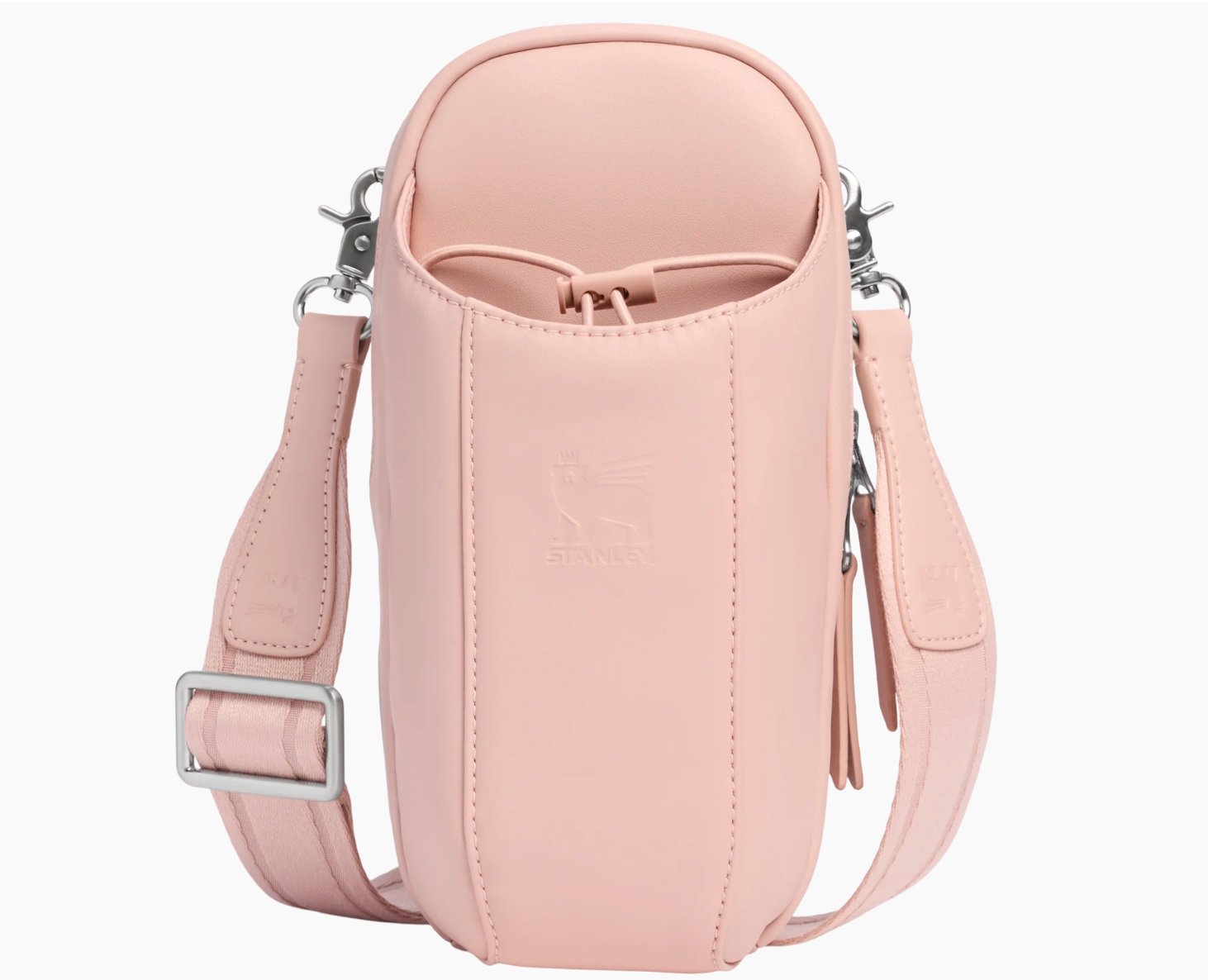
The Clutch Bottle Side-Kit
This is a holder for Stanley’s new The Clutch Bottle. The fanny pack-esque model comes in three colors that correspond with the bottle colors.
Beyond music festival applications, we can also envision this accompanying piece working great for runners or those looking for a hands-free way to carry their bottle while on a walk or a hike through the forest. The side-kit can be worn vertically or horizontally thanks to the adjustable shoulder strap and easy connection clips, giving you a range of styling options depending on your mood. It’s sort of like an elevated fanny pack that can carry a surprising amount.
Investor and entrepreneur Mark Cuban joined Billboard at South by Southwest (SXSW) on Friday (March 13) to talk about why he’s previously said in interviews, and on episodes of the hit TV show Shark Tank, that music — along with other products like liquor brands and clothing lines — is “the death” for investors. The conversation, hosted by Kristin Robinson, was released on Wednesday (March 18) as the first-ever live episode of On the Record, Billboard’s music business podcast.
“Yeah, I think it’s the worst industry ever,” Cuban says with a laugh. “No, it’s probably tied with clothing, branded clothing…that’s the worst, and music is right behind it.” Later, the investor clarified that he was specifically referring to new music and the record labels that release it. To Cuban, older music, also known as catalog, is in a different category entirely — as is music tech.
During the wide-ranging conversation, Cuban talked about how music has become an “asset class,” how his company Cost Plus Drugs can help alleviate financial challenges for artists, why AI agents will create more artist independence and why he thinks the music industry has a lot to learn from sports about integrating prediction markets and betting.
Watch or listen to the full episode of Billboard On the Record with Mark Cuban below or here, or read an excerpt of the conversation further down the page.
You’ve said you don’t believe music is a great investment, but we are seeing a lot of players from the financial world, like KKR and Shamrock, now interested in buying catalogs, like Queen and Britney Spears. Why do you think that is?
To me, that’s not really music investing. It just happens to be music that is the vehicle for their investment. Licensing revenue for music is really consistent, but most artists really haven’t been able to get a big cash out yet, so someone like a KKR or another big investment company will just come in and say, “Okay, I’ll give you all this money [up front in exchange].” And they just see it as, you know, “Here’s my returns.” It’s almost like owning an apartment building for them.
Often, when I speak to investors who are weary about investing in new music tech companies, they say that the exception is that they wished they invested in Spotify. Spotify dominated the streaming era, and now you could argue we are moving into the AI era. Do you think that there’s going to be another opportunity for a Spotify-level AI music company to emerge?
It depends on how consumers take to AI-generated music, because if they see it as an equivalent to what an artist produces, then yes… We don’t know how people are going to respond to purely AI-generated music, but we’re seeing some of it roll up the [charts], so it isn’t that people are absolutely saying no, we just don’t know if they will truly say yes to it.
One thing that a lot of people in the music industry, especially investors in music catalogs, believe is that the music industry is recession-resistant. That music is not correlated to the overall market and will still thrive if the economy tanks. What do you think?
I think it holds up because the worse things are, the more people need music, you know? I’m a big believer that music soothes the soul and makes life livable. But at the same time, again, what is the source of that music? Is it AI or human? That’s what we don’t know.
Your career really took off during the dot-com bubble when you sold Broadcast.com to Yahoo. Do you think we are in an AI bubble right now?
I think for private companies, the economics may be a little bit rich right now, because, like back then, anybody with a website could go out there and raise a million dollars. Now, if you have any amount of decent AI technology, you could raise, in some cases, tens of millions of dollars, but back then, it was a public company bubble. Now, because it’s geared towards private companies, it’s not really a bubble by definition, because most people can’t participate.


What Hiring Managers Want to Hear in Response to ‘Tell Me About Yourself’

Study: Teen girls are using AI to create sexual imagery

BMG Sues Anthropic, Entering AI Copyright Battlefield: ‘Egregious Law-Breaking’

SEND IN THE TROOPS! At Least 5 Dead, 10 Wounded So Far in Chicago Weekend Shootings
How I Paid Off My Mortgage 10 Years Early On A Teacher’s Salary

Black Lives Matter Activist in Boston Pleads Guilty to Federal Fraud Charges – Scammed Donors to Fund Her Lifestyle
-
 Politics6 months ago
SEND IN THE TROOPS! At Least 5 Dead, 10 Wounded So Far in Chicago Weekend Shootings
-
Business6 months ago
How I Paid Off My Mortgage 10 Years Early On A Teacher’s Salary
-
 Politics6 months ago
Black Lives Matter Activist in Boston Pleads Guilty to Federal Fraud Charges – Scammed Donors to Fund Her Lifestyle
-

 Tech6 months ago
Get a lifetime subscription to the “ChatGPT for investors” for under $60
-

 Tech6 months ago
Review: The Dreame H15 Pro CarpetFlex is the first wet/dry vacuum I liked
-
Business7 months ago
25 Low-Effort Side Hustles You Can Start This Weekend
-
Business7 months ago
9 Ways to Command a Six-Figure Salary Without a Bachelor’s
-

 Entertainment5 months ago
Fat Joe Recalls Bruno Mars Snapping on Him Over Question About Puerto Rican Roots: ‘Broke My Heart’