
Politics
77 Years Ago Today, NATO Was Created to Defend the West—But Is It?


WATCH: 77 Years Ago Today, NATO Was Created to Defend the West—But Is It?
77 years ago, on April 4, 1949, the NATO treaty was signed. The alliance, known as the North Atlantic Treaty Organization, was created to deter Soviet expansion and ensure collective security among Western nations.
For decades, it succeeded in that mission. However, today’s geopolitical landscape raises a more complicated question: not whether the United States should leave NATO, but whether the alliance, in its current form, still serves American interests fairly.
Recent tensions surrounding Iran have exposed a persistent imbalance. While the United States continues to provide the backbone of NATO’s military power, many European allies remain reluctant to fully support American-led operations that fall outside a narrow interpretation of Article 5.
That hesitation is not entirely surprising. NATO’s collective defense clause applies when a member is attacked, not necessarily when the United States engages in offensive or preemptive actions.
Still, the broader issue is reciprocity. The United States maintains extensive military infrastructure across Europe, provides advanced defense capabilities, and has historically underwritten the alliance’s security umbrella. In return, Washington expects more consistent strategic alignment.
As previously reported by The Gateway Pundit, President Donald Trump is reportedly considering withdrawing from NATO, reflecting growing frustration within parts of the American political establishment.
However, leaving the alliance is neither simple nor likely. Legislation passed in 2024 requires a two-thirds vote in the Senate to approve any withdrawal, making unilateral action effectively impossible.
This legal reality underscores an important point: the debate is not truly about exit, but about leverage and reform.
It is also important to acknowledge that NATO has not always been a one-sided arrangement. The alliance invoked Article 5 for the first and only time after the September 11 attacks, leading European allies to support U.S. operations in Afghanistan.
Thousands of allied troops were deployed, and many lost their lives alongside American forces. That history matters. It demonstrates that NATO can function as intended when the threat is clearly defined within its framework.
At the same time, structural imbalances have persisted. For years, many NATO members failed to meet the agreed-upon benchmark of spending 2% of GDP on defense. While recent pressure—particularly during the Trump administration—has pushed more countries toward that target, disparities remain.
The United States continues to account for a disproportionate share of total NATO defense spending, raising legitimate concerns about burden-sharing.
Reform, therefore, should focus on three key areas. First, enforceable defense spending commitments must become the norm rather than the exception. While this has largely been the case under Trump, it remains unclear how NATO allies will respond under future administrations.
NATO should also clarify expectations for allied support in operations that, while not strictly defensive, still serve broader Western interests.
Finally, the alliance must adapt to modern threats, including cyber warfare, economic coercion, and strategic competition with powers such as China, rather than remaining overly focused on its Cold War structure.
Leaving NATO would create a vacuum that adversaries such as Russia and China would quickly exploit. The alliance provides the United States with forward operating bases, intelligence coordination, and strategic depth that cannot be easily replicated.
Of course, European nations would likely bear the greatest immediate consequences if the United States were to leave NATO. However, that does not mean withdrawal would be the right decision.
Trump is known for following through on his positions, but that does not preclude negotiation. The same principle applies to NATO: the goal should not be abandonment, but a recalibration of the alliance to better reflect mutual responsibility and shared interests.
The Patriot Perspective has recently switched its main platform from YouTube, and we would greatly appreciate it if you subscribed to us there. [HERE]
Have a question for the show? Like the video and comment your question, and we will be sure to answer it in our next episode’s letters segment. [HERE]
The post 77 Years Ago Today, NATO Was Created to Defend the West—But Is It? appeared first on The Gateway Pundit.


 Today on Stinchfield, NBA rising star Jaden Ivey is suddenly out after speaking out against what he says is a forced LGBTQ agenda inside the NBA. The Chicago Bulls cut him loose, the media calls him unstable, and the left says he is spiraling. But on the right, many see something very different.
A young man standing firm in his faith, unapologetically professing his love of Jesus, and refusing to bow.
So when did faith become a disqualifier in America? And why is speaking your beliefs now treated like a mental health crisis?
At the same time, the dysfunction in Washington hits a new level. Congress is on vacation while the Department of Homeland Security remains unfunded.
Let that sink in. Our national security agency hangs in the balance while lawmakers disappear. The United States Senate, in particular, should be ashamed.
I say bring them back. Do your job. Fund the government. Protect the country.
This is about priorities. And right now, the American people are not at the top of the list.
The post He Loves Jesus, So They Called Him Crazy And Cut Him (VIDEO) appeared first on The Gateway Pundit.
Politics
Supreme Court Rules 8-1 Against Colorado’s Ban on ‘Conversion Therapy’ for Minors – Justice Jackson Dissents
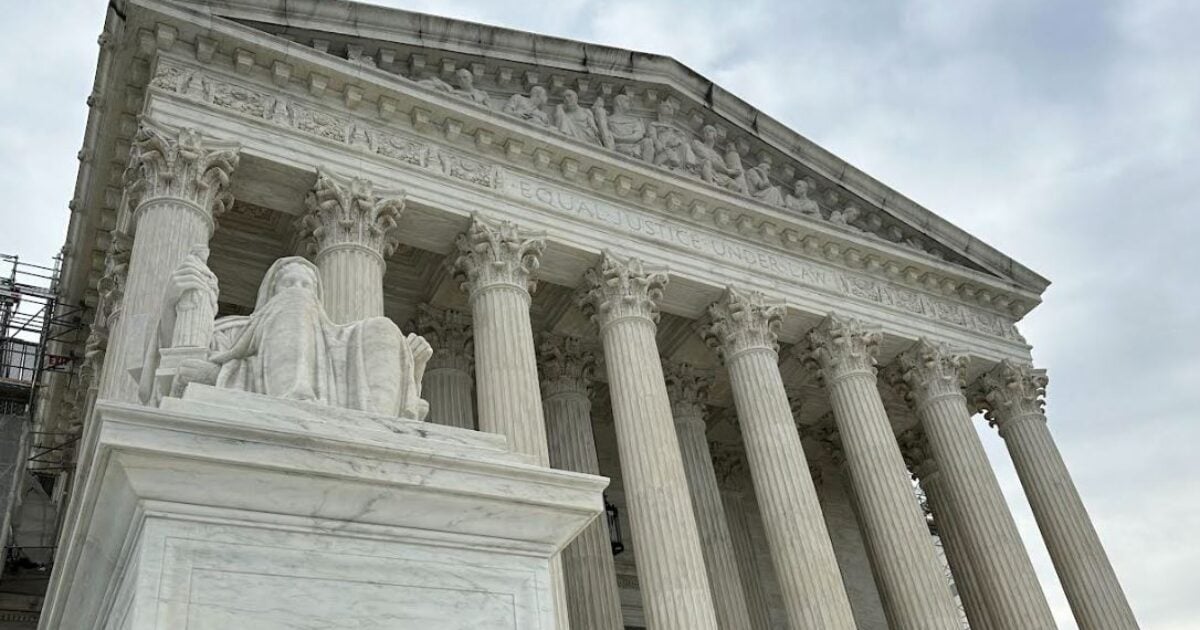

The US Supreme Court on Tuesday ruled 8-1 against Colorado’s ‘conversion therapy’ ban for LGBTQ minors.
Liberal Justice Ketanji Brown Jackson dissented.
The lawsuit was filed by Christian talk therapist Kaley Chiles.
Kaley Chiles argued that Colorado’s ban on her talk therapy methods violated her First Amendment rights.
Chiles counsels children and minor teens struggling with gender identity issues.
Justice Gorsuch agreed and said Colorado’s ban on certain talk therapy methods “censors speech based on viewpoint.”
“Under our precedents, bedrock First Amendment principles have far less salience when the speakers are medical professionals,” Justice Jackson wrote, according to NBC News.
NBC News reported:
In a blow to LGBTQ rights, the Supreme Court on Tuesday ruled that Colorado’s ban on conversion therapy aimed at youths struggling with their sexual orientation or gender identity violates the free speech rights of a conservative Christian therapist.
The 8-1 decision in favor of therapist Kaley Chiles on her claim brought under the Constitution’s First Amendment is likely to have national implications — more than 20 states have similar laws. It could also have an impact on other forms of medical treatment that involve speech.
Writing for the majority, Justice Neil Gorsuch said that “the First Amendment stands as a shield against any effort to enforce orthodoxy in thought or speech in this country.”
Colorado’s law “does not just ban physical interventions,” Gorsuch wrote. It also “censors speech based on viewpoint.”
In deciding the case, the court embraced Chiles’ argument that the Colorado law banning conversion therapy regulates speech, not conduct, as Colorado had argued.
As such, the measure is not like other health care regulations that focus on conduct, the court concluded. The case, decided on the global Transgender Day of Visibility, will now return to the lower courts.
The post Supreme Court Rules 8-1 Against Colorado’s Ban on ‘Conversion Therapy’ for Minors – Justice Jackson Dissents appeared first on The Gateway Pundit.
Politics
Seat to Watch: Connecticut’s 5th District Erupts in Firestorm Over GOP Ben Proto’s Embattled Leadership


The post Seat to Watch: Connecticut’s 5th District Erupts in Firestorm Over GOP Ben Proto’s Embattled Leadership appeared first on The Gateway Pundit.

He Loves Jesus, So They Called Him Crazy And Cut Him (VIDEO)
Supreme Court Rules 8-1 Against Colorado’s Ban on ‘Conversion Therapy’ for Minors – Justice Jackson Dissents
Seat to Watch: Connecticut’s 5th District Erupts in Firestorm Over GOP Ben Proto’s Embattled Leadership

SEND IN THE TROOPS! At Least 5 Dead, 10 Wounded So Far in Chicago Weekend Shootings
How I Paid Off My Mortgage 10 Years Early On A Teacher’s Salary

Black Lives Matter Activist in Boston Pleads Guilty to Federal Fraud Charges – Scammed Donors to Fund Her Lifestyle
-
 Politics7 months ago
SEND IN THE TROOPS! At Least 5 Dead, 10 Wounded So Far in Chicago Weekend Shootings
-
Business7 months ago
How I Paid Off My Mortgage 10 Years Early On A Teacher’s Salary
-
 Politics6 months ago
Black Lives Matter Activist in Boston Pleads Guilty to Federal Fraud Charges – Scammed Donors to Fund Her Lifestyle
-

 Tech7 months ago
Get a lifetime subscription to the “ChatGPT for investors” for under $60
-

 Tech6 months ago
Review: The Dreame H15 Pro CarpetFlex is the first wet/dry vacuum I liked
-
Business7 months ago
25 Low-Effort Side Hustles You Can Start This Weekend
-
Business7 months ago
9 Ways to Command a Six-Figure Salary Without a Bachelor’s
-

 Tech7 months ago
How much does the Roborock Saros Z70 cost? And does it ever go on sale?